
Why Ontario Needs a Public, Citizen-Owned Digital Grocery Co-op
Table of Contents
- The Grocery Price Crisis in Ontario
- A Tax-Free, At-Cost Alternative
- Opening Doors for Local Producers
- Community-Powered Delivery (Dragonfly and Beyond)
- Partnering with Canada Post for Reach
- More Than Business: Public Infrastructure
- Serving Underserved Communities
- Owned by Ontarians – A True Co-op Model
- Conclusion – A Call to Action
The Grocery Price Crisis in Ontario
Ontario families are feeling the squeeze at the checkout. Grocery prices have jumped roughly 20% in the past three years, far outpacing wage growth. Incomes and job opportunities simply aren’t keeping up. The result? More and more households are living paycheque-to-paycheque and struggling to afford basics. Major grocery chains, meanwhile, have enjoyed booming profits – one leading chain’s profit margins soared by over 90% since 2019. It’s clear the status quo isn’t working for consumers.
Ontario needs a bold solution to rebalance the scales. That solution could be a public, citizen-owned digital grocery co-operative. This model aims to reset how we buy our food – prioritizing people over profit, and treating grocery access as a public good rather than a corporate privilege.
A Tax-Free, At-Cost Alternative
Imagine an online grocery platform where everything is tax-free – not just staple produce, but all food items. Right now, Ontario only waives sales tax on basic groceries like milk or vegetables, while prepared foods and snacks still get taxed. A public co-op could eliminate those extra costs entirely, effectively giving everyone an instant ~13% discount on many items. Some policymakers are already pushing to remove taxes from essentials to help Canadians, and a co-op grocer could lead the way.
Products would also be priced at the minimum sustainable cost. That means no hefty retail markups or bloated profit margins – just the price required to pay suppliers and keep the service running. Conventional supermarkets build in profit for shareholders, but the co-op’s mission would be affordability. By operating as a non-profit public utility, the co-op can sell goods at near-wholesale prices. Excess revenues wouldn’t pad anyone’s pockets; they’d be reinvested or returned to members (more on that later). The goal is simple: make groceries as cheap as possible without compromising quality or viability.
This approach could deliver huge relief for consumers. If your $100 grocery basket currently includes $5–10 of hidden markups and taxes, the co-op model could put that money back in your wallet. Over a year, that adds up to hundreds in savings for a family – effectively a pay raise through lower prices. All Ontarians, especially low-income households, would benefit from more accessible, truly affordable food.
Opening Doors for Local Producers
A public grocery co-op isn’t just good for consumers – it’s a boon for Ontario’s farmers and food entrepreneurs. Unlike big-chain stores that often favor large suppliers, a co-op could actively partner with local producers across the province. By listing more Ontario-grown and Ontario-made products, the service would open new markets for small farms, artisanal brands, and co-op suppliers.
Ontario already has a vibrant network of local farmers and food businesses, but many struggle to get shelf space at major retailers. Systemic challenges like distribution and scale hinder their growth. A provincially supported co-op can remove these barriers by acting as a guaranteed buyer and giving local products prominent placement online. From farm-fresh produce and dairy to locally made pantry goods, the co-op would showcase Ontario’s bounty.
This benefits everyone: consumers get fresher, regionally sourced options, and local producers get a fair chance to compete. Over time, a thriving co-op could stimulate more local food production, since growers and makers know there’s a reliable, citizen-backed outlet for their goods. By keeping more of our food economy in-province, we also shorten supply chains and improve food security. It’s a win-win that strengthens Ontario’s food system from farm to table.
Community-Powered Delivery (Dragonfly and Beyond)
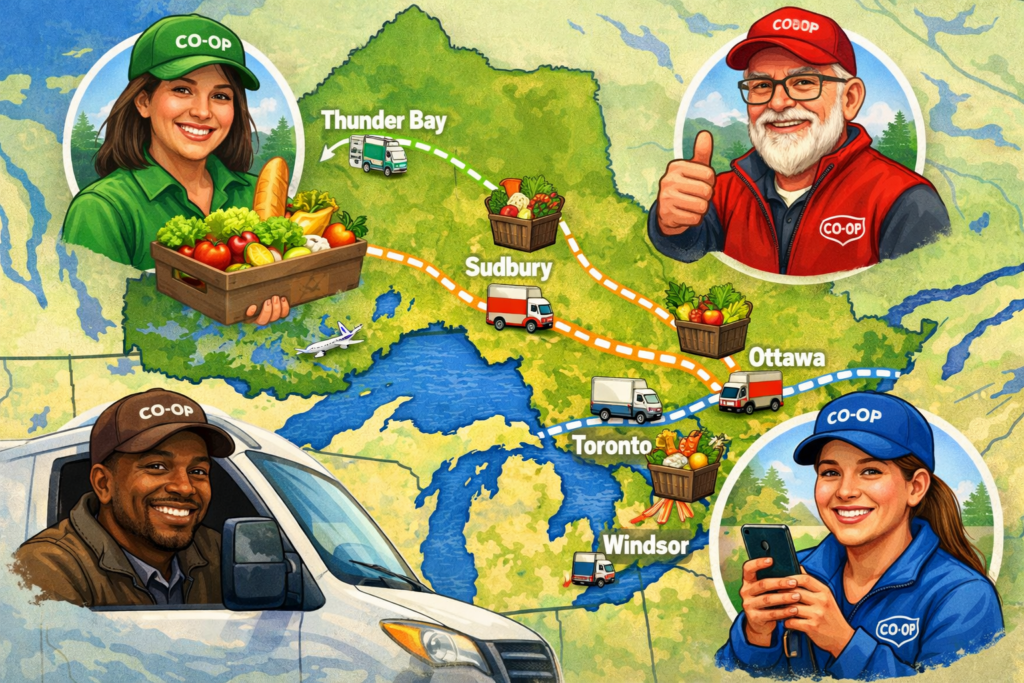
How would a digital co-op get orders to your doorstep? By embracing innovative, community-powered delivery models. Instead of a costly corporate fleet, the co-op could leverage crowd-sourced delivery and pickup options that engage everyday Ontarians (and reward them for helping out).
One idea is a community courier program: local drivers (your neighbors!) could sign up to deliver grocery orders in their spare time, paid in cash or store credits for their service. This model creates flexible gig opportunities and keeps costs low, since the co-op isn’t hiring a massive staff of drivers with full-time salaries. Participants could even opt to take their compensation as co-op credit, effectively exchanging a bit of labor for discounted groceries – a mutually beneficial trade.
In the early stages, existing delivery startups could assist. For example, services like Dragonfly Shipping – a flexible Canada-wide logistics network – could help power last-mile deliveries. Dragonfly already partners with businesses across Canada and operates 7 days a week, so teaming up with them could rapidly expand the co-op’s reach. Their technology and expertise would ensure that even smaller communities get reliable delivery service from day one.
Partnering with Canada Post for Reach
For long-term, province-wide coverage, the ideal delivery partner might be Canada Post. As a public postal service with a mandate to reach every address, Canada Post is uniquely positioned to handle broad grocery distribution. Imagine co-op orders riding along in Canada Post trucks, arriving with your regular mail – convenient and efficient.
Crucially, Canada Post is a Crown corporation, not a profit-hungry private courier. In fact, the federal government in 2018 explicitly directed Canada Post to focus less on profit and reinvest its earnings into better services. Partnering with a citizen-owned grocery co-op fits perfectly with that public service mission. Any modest delivery fees or revenues from the co-op work with Canada Post would go back into improving postal operations (or offsetting its losses), not into shareholders’ hands.
This partnership could also breathe new life into Canada Post, giving it a meaningful role in modern daily life beyond mail. As letter volumes decline, delivering groceries and parcels is the future – a co-op contract would leverage Canada Post’s vast network of postal workers and infrastructure for the public good. It’s a natural synergy: use existing public infrastructure to deliver an essential service (food), instead of duplicating efforts or relying solely on private couriers.
More Than Business: Public Infrastructure
A citizen-owned grocery co-op should be run like public infrastructure, not a business. Think of it as akin to our roads, libraries, or water systems – essential services provided for public benefit, not for competition or profit. This mindset is key. It means the co-op’s success won’t be measured by quarterly profits, but by how well it serves Ontarians (e.g. lower food insecurity, savings for households, happier producers).
Critics might sneer that this sounds “anti-competitive” or like “socialism.” But that critique misses the point. No one calls public schools or highways “anti-competitive” – they fulfill needs the market alone isn’t meeting, operating alongside private options without issue. A public grocery is infrastructure, not retail. Its purpose isn’t to dominate the market or crush competition; it’s to ensure a basic standard of access to affordable food for all citizens, much as public healthcare ensures access to medical treatment.
In fact, creating a non-profit co-op could increase competition in a sector dominated by a few big chains. If private grocers truly offer superior service or products, consumers can choose them. But the co-op will be there as a safeguarding presence, preventing those chains from price-gouging with impunity. The existence of a public option keeps everyone honest – a similar logic to having public universities alongside private colleges. It sets a baseline of quality and affordability that for-profit players must at least match or justify.
Far from some fringe experiment, treating food access as infrastructure is an idea with real precedent. For example, the city of Belo Horizonte in Brazil virtually eliminated hunger by treating food as a public utility, coordinating markets and food distribution as a public service. They proved that when you plan and deliver food systems publicly (rather than leave it all to market whims), you can achieve incredible social outcomes. Ontario can take inspiration from such success while tailoring it to our local context and co-operative ethos.
Serving Underserved Communities
One exciting feature of a successful digital co-op could be its expansion into the physical world, opening brick-and-mortar locations in underserved communities. Many low-income or rural areas in Ontario are “food deserts” – places with no nearby grocery stores or fresh food markets. Residents in these areas often pay more for food (at convenience stores) or travel long distances to find full-service grocers.
If the co-op proves popular online, it could establish pickup hubs or small community grocery centers in such neighborhoods. These wouldn’t be sprawling supermarkets, but modest outlets where members can retrieve orders or buy basics in person, at the same fair prices. By going where private retailers won’t, the co-op can directly tackle food inequity. Physical presence also serves those who may not be as comfortable with online ordering, such as some seniors.
Importantly, any brick-and-mortar expansion would be driven by community demand and done sustainably. Profits from the co-op (if any) could be reinvested to fund these new locations. It’s a stark contrast to corporate chains that open stores based purely on profit potential and often abandon areas that aren’t “worth it.” A public co-op’s mandate is to serve Ontarians, not leave people behind. From Northern towns to inner-city Toronto, wherever there’s a gap in grocery access, the co-op can step in over time.
Owned by Ontarians – A True Co-op Model
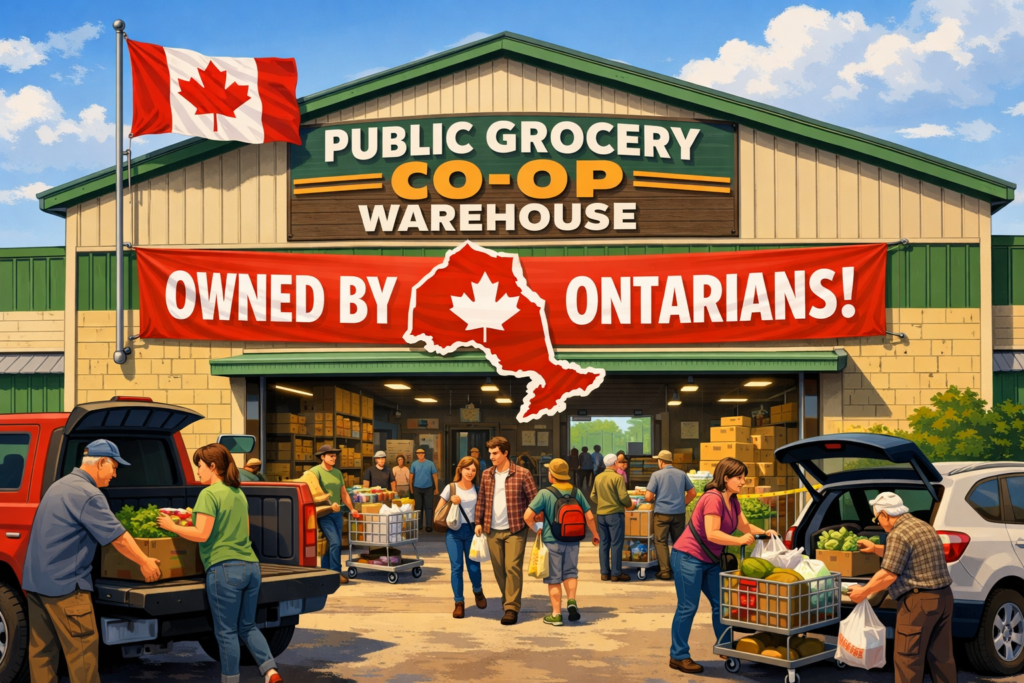
Perhaps the most revolutionary aspect of this idea is who would own the grocery co-op – not government, and not private investors, but the citizens of Ontario themselves. Just like member-owned co-ops elsewhere (think Mountain Equipment Co-op in its heyday, or credit unions), every Ontarian could become a member-owner of the grocery network with a small one-time buy-in (for example, $10 or $20 for a lifetime membership).
Structurally, this would resemble a Costco-style co-op, but with even more democratic control. Members would elect a board, have a say in major decisions, and share in the benefits. Any excess earnings at year-end would be returned to members as dividends or reinvested to improve the service. In cooperatives, surpluses that aren’t needed for operations are often paid back to members proportional to their use of the co-op. That means if the co-op ever does turn a profit, it comes back to you – either as cashback, store credit, or community investment (opening that new location, for example).
This model ensures the co-op remains accountable to the public interest. There’s no risk of some future government selling it off or a corporate takeover, because the owners are the people. The co-op would operate under co-operative principles protected by law. And unlike a pure government program, it isn’t taxpayer-funded or subject to political whims each budget cycle. It runs on member equity and revenues from sales, making it self-sustaining and independent. In short, it harnesses entrepreneurial efficiency without private greed.
By being owned by ordinary Ontarians, the co-op directly empowers citizens in the economy. We become not just consumers, but stakeholders. Imagine receiving an annual dividend cheque because the grocery co-op did well – essentially getting money back just for buying affordable food! That’s the opposite of today’s setup, where higher grocery bills just mean bigger corporate profits for a few billionaires. This isn’t pie-in-the-sky; it’s a proven co-operative practice worldwide, aligning incentives so that the business serves its members, not the other way around.
Conclusion – A Call to Action
Skyrocketing grocery prices and corporate consolidation are not facts of nature – they are challenges we can address with the right vision. A public, citizen-owned digital grocery co-op is a bold idea, but it’s also common sense: make essential food affordable by running the grocery system as a public service, owned by the people who use it. Ontario has an opportunity to lead Canada in this innovation, pioneering a model that could inspire similar efforts across the country.
Such a co-op won’t magically appear on its own. It will take political will, grassroots advocacy, and perhaps a pilot project to prove the concept. This is where you come in. Talk to your friends and family about the idea. Share this concept with your local representatives and ask where they stand on food affordability. Support politicians or organizations that prioritize breaking up monopolies and empowering co-ops. If you have the means, you could even join with others to start a local co-op grocery initiative that might grow into the larger vision.
The bottom line: Ontarians deserve better than paying the highest prices in decades while a few companies reap the rewards. Let’s channel our frustration into constructive action. By pushing for a public grocery co-op, we’re not attacking business – we’re building infrastructure for the public good. We’re saying that in a province as prosperous as Ontario, no one should go hungry or bankrupt just to feed their family.
It’s time to demand a grocery system that puts people first. Together, we can create a citizen-owned co-op that delivers fair prices, supports our local producers, and treats food as a basic right, not a luxury. The benefits – economic, social, and ethical – are simply too great to ignore. Let’s make it happen, Ontario.
Sources:
- Statistics Canada – Consumer Price Index and food inflation data (2021–2024)
- Global News – Report on rising grocery profits amid inflation
- Royal Society of Canada – Local food infrastructure policy brief
- Dragonfly Shipping – Official site (delivery network across Canada)
- Canada Post – Government directive on reinvesting profits (2018)
- Co-operatives in Canada – Co-op principles and patronage dividends
